
Metabolising Regeneration: Evolving Our Paradigm at REAL School Budapest

More than twenty years ago, I chose the path of an educator because I wanted a life that would be intellectually enriching while having a genuinely positive social impact. I’d had difficult experiences in school. My junior high taught me street smarts as much as book smarts. I remember it as a bizarre blur of academic rigour, extortion evasion, and basketball. I fit in less well in high school and spent most of my years stressed and clinically depressed. University was even worse.
Something inside me, however, made me believe that I could have a role in reshaping education — or rather, schools — around more humane and meaningful experiences. Two decades and 27 countries later, I think I can authentically point to a number of ways in which I have made such a contribution. This piece is the beginning of a Substack series about my most recent attempt to do so at REAL School Budapest, where I am leading the emergent co-design of a new model of schooling, one centring on regenerative entrepreneurship and wellbeing.
The purpose of this article is to share some of my thinking about what regeneration is, why it can help us shift our thinking about the purpose of schools, and what it would mean to partake in regenerative education practices. I share this not to try to convince anyone of anything in particular but instead to open a wider dialogue about the purpose of schools and how we might design them to better meet the pressing challenges of our era.
This piece is inevitably imperfect and that’s okay. Please do not hesitate to point out flaws in my thinking. The best critique I got from early readers of this was that I overlooked what one person called, “regeneration of the mind.” I concede that point and will address some of the deeper introspective, relational, and ontological aspects of regeneration at another time. I will also share pieces on what we have been doing, including on our whole-school competency-based curriculum and assessment model, development of AI tools to support learning design and delivery, and a pedagogical model for regenerative action I am developing called SEEDS.
This piece is an excerpt from a much longer document and I have chosen to keep it in its original form. The impetus came from Benjamin Freud, Head of Upper School at Green School Bali, who kindly reached out to us to collaborate on a student project. He shared an intriguing model of regenerative education design for their Biomimicry in Regenerative Design (BiRD) Lab called the 4S’. I needed to do my own research and thinking to figure out how we might more meaningfully engage in regenerative action through our Dream-to-Reality (D2R) project-based learning programme in our own context. It was in that context that the following was written. Only very minor edits have been made.
—
Regeneration – Why and What?
Why focus D2R on regeneration? What is it anyway? These are key questions, not only to establish collective clarity but because it is fairly obvious that we do not yet share a common understanding of what regeneration is and why some of us feel it is so badly needed. This is a problem since it is already embedded in our D2R Programme Overview, which states the following core purpose:
“Dream-to-Reality (D2R) equips students to design, test, and launch impactful, entrepreneurial solutions that strengthen and regenerate our communities and planet, while simultaneously building strong literacy, communication, and entrepreneurial skills.”
The impetus for a regenerative focus arises from our shared context of crisis (edit: regeneration would arguably still make sense even in a perfect world). Indeed, the manifestations of crises are many: climate heating, authoritarianism rising, migration surges, deepening political polarisation, biodiversity collapse; the list goes on and on.
While each of humanity’s major challenges on its own is a travesty, evidence of our persistent immaturity as a species, no one crisis happens in isolation. Instead, each crisis connects with others in an interdependent cascade of emergencies, reinforcing and amplifying effects. As housing and basic goods prices rise and employment erodes, frustration leads to scapegoating and political polarization, making democracy weaker and populist authoritarians more appealing. As more despotic rulers take over control, power-checking institutions lose independence, civil liberties are curtailed, people lose trust, investment dries up, and economic instability spreads. Problems compound problems.
Such feedback cycles occur because human activities happen across multiple interconnected systems. The climate crisis fuels mass migration which fuels xenophobia and self-inflicting damage like Brexit. Covid disrupted supply chains, driving prices higher, and drove waves of misinformation. Social media messages accelerate these dynamics through algorithmic incentives that propel profit by feeding us fear narratives. While it is often hard to see or comprehend patterns amidst complexity and uncertainty, what happens in one part of human systems spreads into others. Crises beget crises in one awful web of enmeshed calamity. This phenomenon is often called the polycrisis.
Confusingly, the crises of our times are also referred to as a metacrisis, or a crisis of crises. Not only are we tied up in an interwoven knot of connected crises that is greater than the sum total of related emergencies, but a deeper pattern is at play under the surface. What underpins and acts to perpetuate the polycrisis is a set of beliefs and assumptions about who we are, how the world works, and how we relate to it.
Often what appears to be a technical, economic, or regulatory problem on the surface is fundamentally a problem of culture – what we believe to be important and hold to be true. Take climate change. On the surface, it is a problem of fossil fuel overuse in which solution options swing between questions of regulation and clean energy investment. But underneath, it is driven by a set of beliefs about what we need to live a good life: endless economic growth is usually assumed to be necessary and possible, nature is seen as there for us to exploit for our own ends, and in the grand scheme of things, we implicitly accept that individual or national gain outweighs ideals of collective flourishing.
These invisible assumptions and others like them tend to be taken for granted. If discussed at all, they are commonly accepted as the natural, normal, inevitable, and unchangeable way of doing things. They become the operating system for our societies. Unless we change the way we make sense of the world and our place in it under the surface of things, the argument goes, we are embroiled in a metacrisis, which ensures that the more surface-level polycrisis will persist and deepen.
The youth mental health crisis may be a phenomenon that blurs the boundaries of these categories. It is quite visible to anyone who works with young people, but it relates to patterns of addiction, meaninglessness, hopelessness, and impossible expectations that permeate youth culture and are bound up with basic assumptions about their place in the world, or a lack thereof.
Whether we call it a metacrisis, a polycrisis, or something else, it is undeniable that we are caught in a deep systems crisis. Unlike previous crises over the span of human history, what sets this moment apart is that this one may be existential. Insofar as we treat planetary boundaries like arbitrary colouring book lines, and cross them with utter disregard for the ecological implications, we may be creating the conditions for our own demise by triggering irreversible feedback loops in planetary systems. And even if there is more hope than it may seem, the fact that we are degrading and depleting life is undeniable.
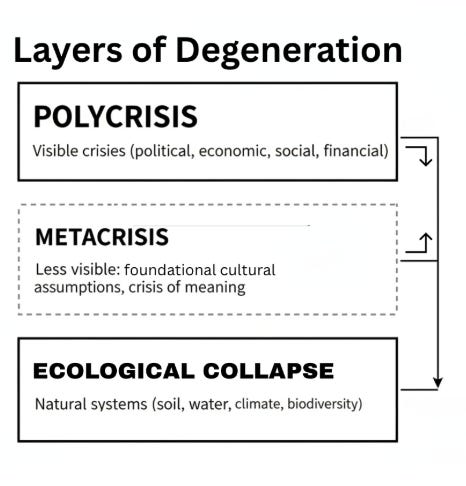
Given the seriousness of our situation, if we have the opportunity to design a new model of education around whatever we want, I suggest we do it around coming to grips with what I for simplicity’s sake call the degeneration crisis and build a model around regenerative action. As trite as it may sound, I think we should help kids take real action to stop things from breaking apart and help heal the world.
What, then, would that mean? What exactly are degeneration and regeneration?
The term, regeneration, derives from the Latin, regenerare, which means to “create again” and was initially associated with ideas and processes relating to spiritual renewal, restoration, and rebirth. In the late 1980s, the term, regenerative, began to be used in agriculture to describe processes used to renew and revitalise soil and ecosystems. Such practices, of course, are much older. Most indigenous communities around the world used regenerative techniques millennia ago and many still do.
The core idea of regeneration is to use life to support and beget life. As the noted environmentalist, Paul Hawken, defines it, regeneration means “putting life at the center of every action and decision.” In a brilliant article I would urge us all to read entitled, The Regenerative Lens: A conceptual framework for social-ecological systems, Sam Bukton et al. put it a little differently. They state that “regenerative social-ecological systems—regions, economies, cities, businesses, communities, and so forth—can be defined as those that maintain positive reinforcing cycles of wellbeing.” Note that this is a systemic and dynamical definition; something exists in a regenerative state if and only if it positively perpetuates, a key distinction we will return to shortly. By contrast, if regeneration is about renewal and systemic revitalisation, degeneration describes the opposite: anything that depletes and degrades systems that support life. The degeneration crisis is likewise systemic.
The intentional use of the term, regeneration, as opposed to the more common term, sustainability, is based on the recognition that the latter is inadequate in our current context. The root of sustainability is the word, “sustain,” which means to “hold up” or “endure.” Sustainability thus refers to the notion that we should use resources in ways that meet the needs of the present without compromising the ability of future generations to meet their needs, too.
While sustainability is necessary, it remains insufficient. Our planet has been pushed too far for sustainability to be enough. As a species we consume too much, our climate has heated up too much, and our ecosystems are too depleted of life to keep the pattern going in perpetuity. We have crossed too many major planetary boundaries to keep the game going. Instead, we need to take active steps to help heal our degenerating systems so they may regenerate: we need to find ways to allow life to heal life.
This discursive turn is chosen to both underline the urgency of action and to present a pedagogy of regeneration that goes beyond mere knowledge and skills to one that has an enduring impact on the systems of which we are part. Connecting to nature and developing eco-literacy are important yet arguably stop short of cultivating the kind of knowledge, skills, care, and action that our world and our young people need at this point in the human story.
One might reasonably argue, however, that holding ourselves and our learners to such a standard may be too difficult. I would agree that it is a very high bar, and indeed if we are to reach it, we may need to do D2R quite differently. It might also be the case that we opt not to authentically embed regeneration in our school’s program despite it being the ‘R’ in our ANSWER framework. But I would ask us to first consider what it would mean to do so, and invite us to collaborate on making that choice intentionally, one way or the other. To do that, we will need to dive into the concept of regeneration more deeply.

Regeneration: Deepening Our Understanding
I wish to offer the following working definition of regeneration and then walk us through what it means:
Regeneration refers to forms of organization, design, and action that grow the capacity of people and places to become healthier over time through reciprocal, place-based co-evolution — going beyond “do less harm” to supporting enduring net-positive system health.
To help clarify the components of this definition, the graphic below is quite useful. Developed by regenerative designer, Bill Reed, it situates regeneration at the polar end of a continuum of actions where actions are relatively degenerative, neutral, or regenerative with respect to ecological and social systems.
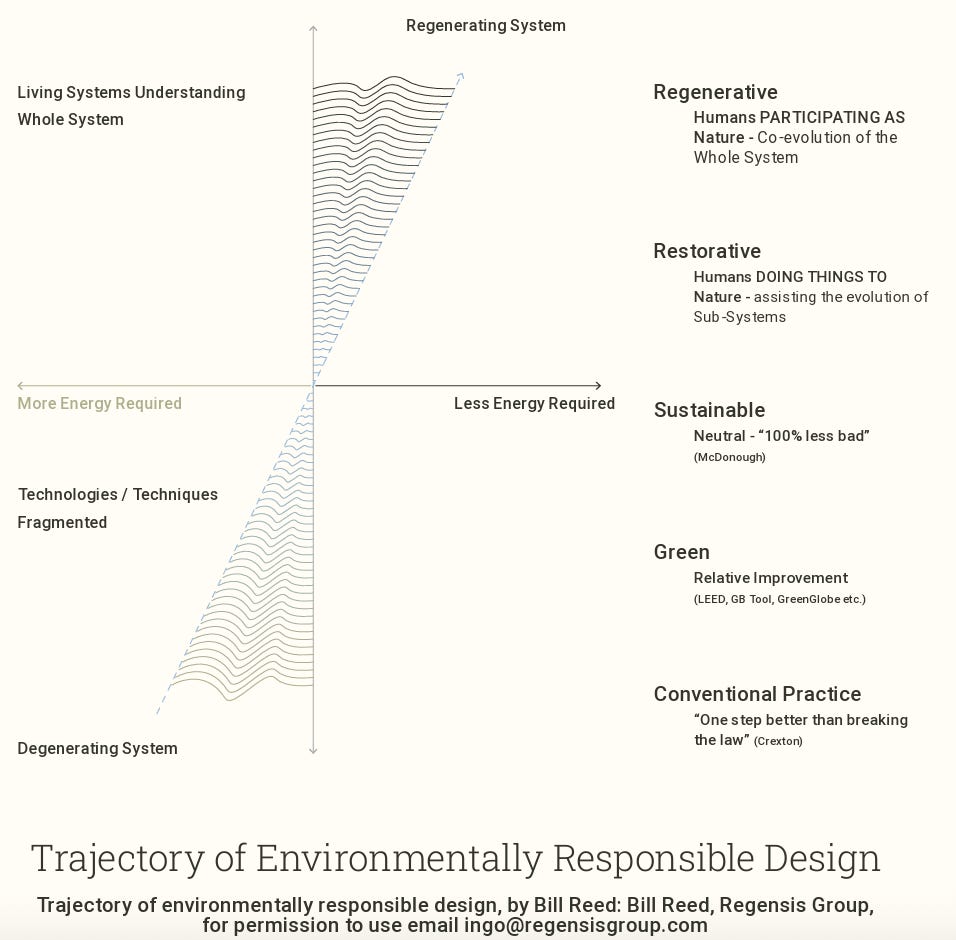
Working up from the bottom, each level of action moves towards greater impact on systems health:
Conventional action leaves the system as is, which is generally part of a life-depleting degenerative process within an extractive economic system. In other words, it keeps the degeneration crisis in place. There is no real interest or attempt to change the system, and often people focus mostly on increasing efficiency or increasing profit. “Fast fashion” apps are a good example, but almost all corporate activity falls under this category.
Green action is often described as “do less harm” by focusing on reducing the negative impacts of existing practices, such as via “corporate social responsibility” initiatives. These may trim waste to an extent they do not change underlying system patterns. We might swap bulbs for LEDs but ignore habits of energy use and procurement, for example.
Sustainable action maintains the biospheric status quo by using resources in ways that allow future generations to use them as well. This might mean adding bottle-refill stations and banning single-use bottles. That helps, but past harm remains and regenerative capacity does not grow.
Restorative action repairs a part of a problem but ignores the root causes and complex system dynamics. We might clean a river or plant trees in a depleted area, but without upstream systems change, the problem returns. In other words, restorative efforts often focus on treating the symptoms of degeneration, rather than redesigning the social, economic, or ecological systems that created the damage in the first place
Regenerative action shifts an upstream or root cause and leaves capacity that endures. We might redesign a supply chain with local vendors, add a compost loop, and create a steward team so the practice continues and improves. This approach transforms systems in ways that enable people and places – and the greater system of which they are part – to become healthier, more resilient, and capable of continual growth over time. Unlike temporary solutions, the positive effects do not fade; instead, they multiply and reinforce regeneration across the system.
Judging by this standard of regeneration, our D2R projects have usually not met the mark. But that is understandable, however, given that we lacked clarity about what it means to do genuinely regenerative work. Interestingly, I do think we can point to several projects that have come close: Paws for a Cause, where students made toys and raised funds for sheltered animals, was arguably restorative. The Fire Dragons food waste project last year may even be characterised as meeting a regenerative standard, as the compost practice endured.
We might also use this standard of regeneration to self-assess our school as a whole. To what extent are we a regenerative school? Bukton at al. developed the graphic below to illustrate the multidimensionality of regeneration, noting that groups or organizations can be internally regenerative, yet at the same time externally degenerative, and vice versa.
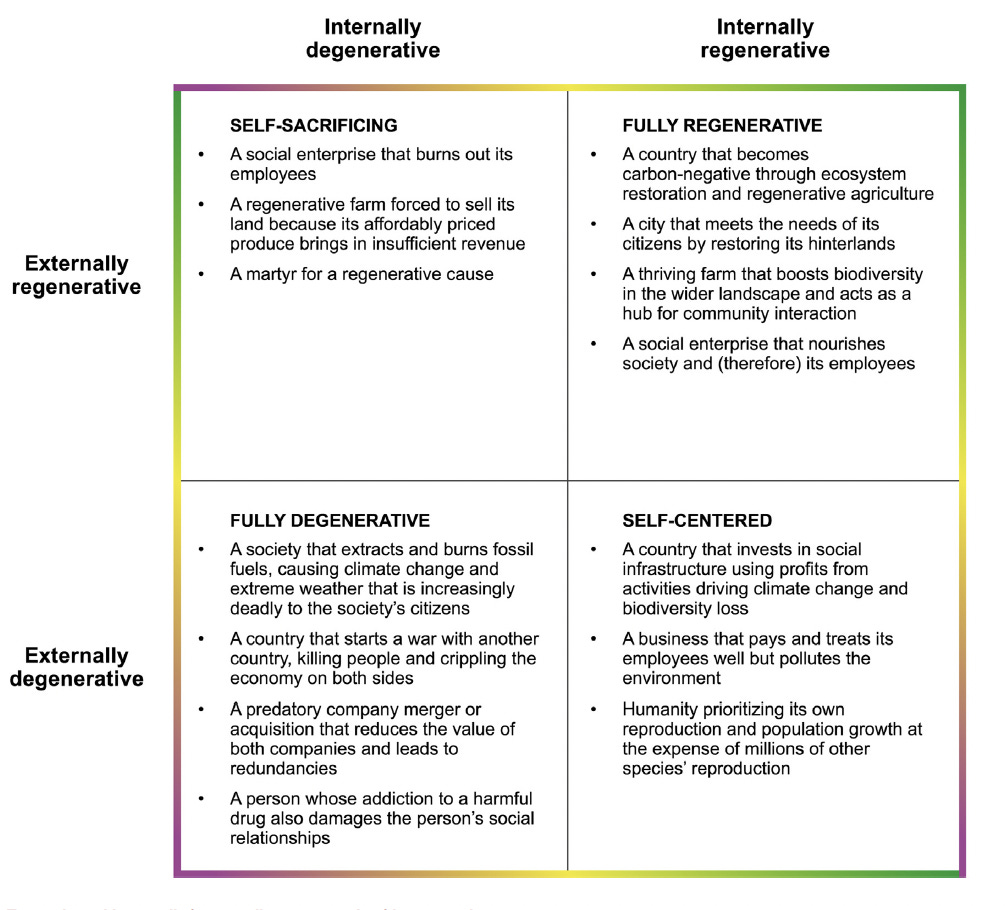
I think this is a useful framing device for analysing the impacts of practices in schools. While all schools purport to make the world a better place, many critical theorists (e.g., Bourdieu; Bowles and Gintis; Apple; Giroux) argue that schools tend to replicate the dominant social order by preparing young people for jobs in an inherently extractive and oppressive capitalist system.
If we were to accept that premise, it would follow logically that schools could be characterised as being externally degenerative. Similarly, inasmuch as schools inculcate conditioned habits of conformity and deference to authority rather than supporting learners to develop self-awareness and self-determination, while at the same time imposing onerous expectations that lead to excess levels of stress, burnout, anxiety, and depression, they can be seen as internally degenerative institutions. Likewise with impacts on teachers. I would encourage us to use this framing to ask ourselves honest questions about our degree of both internal and external regenerativity and aim to become increasingly regenerative.
While I find the above tool useful, I would nevertheless caution us to avoid using simplistic binaries. While some systems and practices are categorically obvious, many may embody elements of both. Take AI, for instance. Depending on how we choose to direct AI, it could be a major force multiplier of the degeneration crisis through environmentally depleting data centres, growing mass surveillance, cognitive and emotional dependence, and so on. Yet it might also cure cancer, help us restore ecosystems, and create a three-day work week. How we use AI will likely have both degenerative and regenerative elements. The yin and yang of things are sometimes inseparable.
I think employing a regenerative lens to assess impacts is nevertheless useful because it helps us ask deeper and more sophisticated questions about systemic consequences, which in turn can help us make more ethical and life-affirming decisions. A regenerative lens is especially useful when designing and evaluating curricula. I will now turn to this topic and explain how it might help us evolve not only D2R, but our whole-school program.
Curriculum Through a Regenerative Lens
Given our definition above, it is very difficult to find curricula that fully meet the criteria for regeneration. Indeed, if curricula are regenerative only if they produce an enduring net-positive impact on both people and place, promoting the health of the system as a whole, then almost no curriculum on Earth is truly regenerative.
This goal asks a lot more than most schools are willing or able to give. It requires that we move beyond the confines of the classroom, go out into the world, ask deep questions, examine potentials, understand the systemic underpinnings of complex problems, and take some tangible action that both works and continues to work in ways that support the flourishing of life in a particular place and over the long term. Very few schools do that.
It is easier, on the other hand. to find degenerative curricula. Many mainstream business studies and economics courses are arguably degenerative insofar as they proliferate assumptions about extraction, valorise profit above all, legitimate environmental externalities, and present an implicit hegemonic ideology that reinforces beliefs and actions that compound net-negative system health.
In some cases, curricula that could easily be regenerative are instead quite the opposite. Take this question from the 2023 AP Environmental Science Exam in the United States, as an example:

Rather than allocating time and energy towards helping students learn how to heal environmental systems, learners are required to become more effective analysts of extraction and degeneration. While this is an egregious example, it is not extreme; it exemplifies the norm within a dominant paradigm that too often is assumed to be normal and unchangeable.
It is difficult to find curricula that are even aspirationally regenerative by design. Green School’s BiRD Lab approach is one. This terrific regenerative economics curriculum that is spreading in schools may be another. Forest schools around the world may meet the mark. The International Baccaleurate has the Community, Action, Service (CAS) programme that ostensibly aims at regeneration, as well.
But do these programmes really meet the high benchmark for regeneration stated above? To do that, they have to have a tangible, real-world impact. Simply teaching about regeneration seems insufficient, as it most likely doesn’t produce enduring net-positive system health, at least directly. But how about indirectly? Can we really know the impacts of a given curriculum in the long-run? How can we possibly know whether what we teach leads to regenerative or degenerative impacts in the future? I don’t think we can. Yet, is it not fair to say that a curriculum embodies latent impact potential to the extent that it supports understanding of how the world works and how we might make it a better place? Would it not be reasonable to assert that regenerative economics carries more latent potential for good than, say, a standard maths class, which could just as easily empower a person to design addictive social media algorithms as it would bicycle lanes?
In my view, while it is useful to hold up a high standard for determining whether a learning experience is genuinely regenerative, that does not mean that we need or should dismiss life-affirming activities that might not fully meet that standard but could reasonably grow knowledge, skills, or beliefs that could empower learners to take regenerative action in the long-run.
Rather than fitting neatly into one category or the other, I believe curriculum and learning experiences are more usefully positioned along a continuum of relative regenerativity like the one here:

As a simple exercise, we might reflect on some of the experiences we have guided students through in the past and consider where they would lie along this spectrum. When I sailed across the Atlantic Ocean with students on Class Afloat, we would often stop at ports to do service work. In the Dominican Republic, for example, we painted poor people’s houses and in the Azores we spent hours cleaning up plastic and styrofoam on a beach. Neither action would meet the full standard for regeneration, as we learned next to nothing about the systems that kept poverty and pollution, respectively, in place. Nor did we do anything to help heal the systems long-term. Our work was restorative at best.
But what was the impact on the beliefs and identities of the students? Did they simply walk away feeling like self-satisfied saviours, or did their self-concepts as compassionate actors shift in some enduring way? I honestly have no idea. But I would say both actions were worth doing and probably better than solely reading about poverty or pollution.
This is not to downplay the importance of knowledge, however. Without a deep conceptual understanding of systems, problems, and possibilities, it is impossible for us to take regenerative action. Both knowledge and action matter. Emotional experiences very much do as well, though those are much more difficult to foster. If learners feel good while studying about the world but feel terrible while taking action (or the other way around), what is the impact of that? So much in teaching is quite outside of our control.
Focusing on what we can reasonably design for, I think it is useful to complexify the regenerativity continuum above with a vertical axis moving from knowledge to action. Rather than seeing these solely as relative degrees, however, I construe the relationship between knowledge and action to be more developmental, with knowledge functioning as a ground upon which action is more effectively carried out.
I agree with Afred North Whitehead that knowledge without action is “inert” and of little value; conversely, I would also assert that action without knowledge is bereft of wisdom and pedagogically unsound. We could, for example, engage kids in regenerative farming without helping them understand the science behind it, but that would stunt their growth. Wise action combines knowing with doing in a recursive and reflective process.
Whether a learning experience leans more towards knowledge or action is useful to consider when planning curriculum. Consider the following diagram, which adds an extra dimension to the one above:
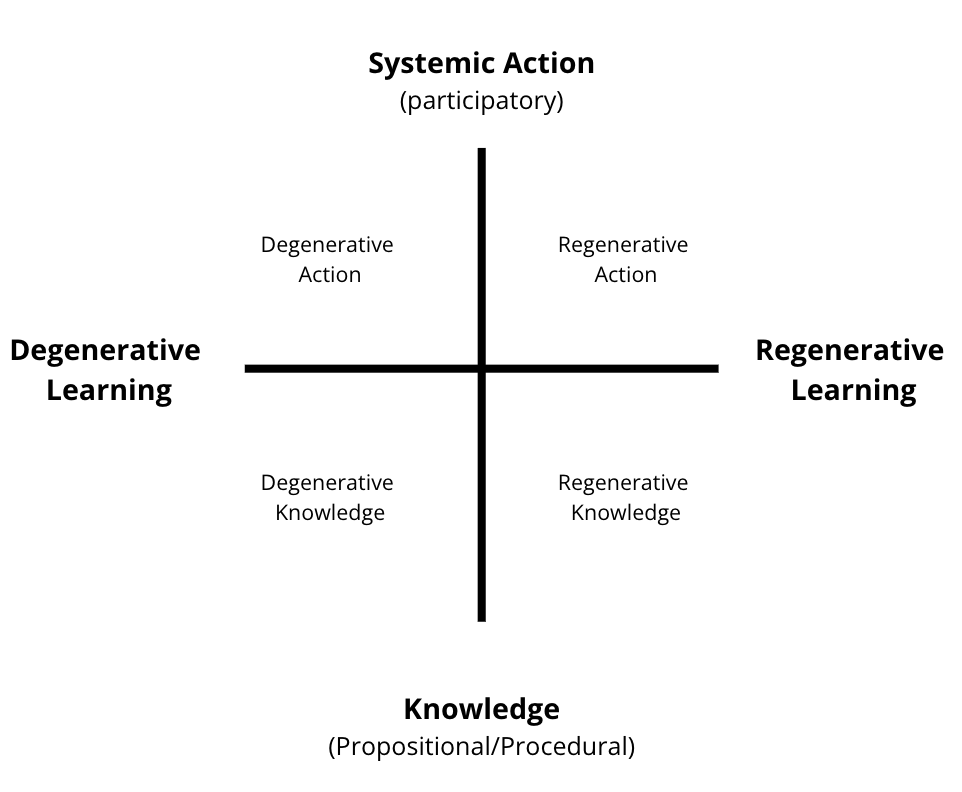
Adding an additional axis creates a quadrant that allows us to signify any given curriculum or learning experience in terms of both its relative regenerativity and its orientation to different ways of knowing. Borrowing from cognitive scientist John Vervaeke’s four ways of knowing model, we can say that curricula that aim to generate knowledge of facts and concepts (propositional knowledge) or skills (procedural knowledge) lie at one end of a spectrum, whereas those that aim to engage learners in real-world action (participatory knowledge) lies on the other. In this model, systemic action is positioned at the polar end, with other forms, such as restorative, sustainable, or conventional action lying more towards the middle.
As an aside, it is interesting to note that Verkaeke’s fourth form of knowledge, perspectival, which describes how people embody and interpret situations in context (e.g., through awareness of the experience of action or of taking a test) permeates all four quadrants, as all activities are in a cognitive sense experiential and perspectival. One might also argue that all classroom-based experiences, even if focused on knowledge and skills, are also participatory. I concede that, but importantly, participatory knowing, as Vervaeke frames it, is not just about participation in a social or class activity. It emphasizes the deep integration of the learner within an ongoing process or community of practice, which means it fits systemic action better.
We can use this quadrant to more deeply reflect on and plan curriculum. It may help us avoid a “bias to action” that devalues knowledge building, one of the major issues with our D2R programme mentioned above. Here is an example of what that might look like:
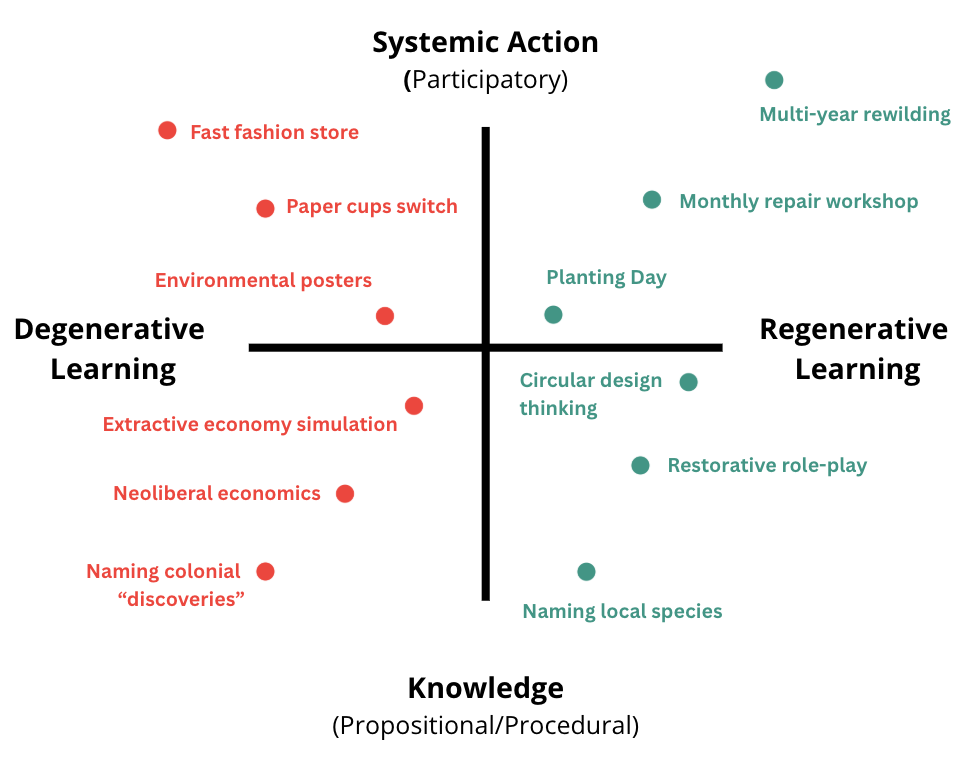
Taking this conceptual approach addresses some of the challenges key thinkers in the environmental education movement have highlighted. Jensen & Schnack developed the action competence framework, a foundational model in the field of environmental education, which focuses on empowering learners to move beyond the knowledge pole (eco-literacy) to take meaningful action regarding immediate environmental problems. While important and worthwhile, this aim arguably falls short of our regenerative aspirations. By explicitly emphasising and fostering students’ capacities to regenerate and co-evolve systems over time, a pedagogy or regeneration is arguably deeper and more needed,
Regeneration at REAL School
Our website brands us a “school for regeneration.” Our ANSWER framework also explicitly embeds both regeneration and nature-based learning in our curriculum, and we launched a Regeneration programme this past August. I’m honestly really happy about all this. I think we can already make credible claims about cultivating regenerative knowledge in our learners, but I am less certain about whether our designs focus as much on regenerative action as they might. How regenerative do we want our programme to be? Is our aim to engage learners in the highest standard of regenerative action and thereby take seriously the need to support net-positive system health for people and place, or are we happy to stop short of that given our situational constraints?
We need to make conscious choices one way or another, and I hope the above discussion helps us do that. Something else that might nudge us towards taking a regenerative leap is that our learning targets already embed that standard. In fact, one might worry that they are too ambitious, as they demand that by the end of year nine that kids will be doing de facto regenerative systems design.
Our competencies and learning targets (LTs) have been designed using a different framing logic than the knowledge to systems action progression outlined above. Inspired by, and designed to explicitly link to the EU GreenComp competency framework, our Regeneration and Nature LTs begin with awareness, move to action, and culminate at the highest level in systems change. The graphic below visualises this by juxtaposing two LTs at levels 1, 6, and 9:
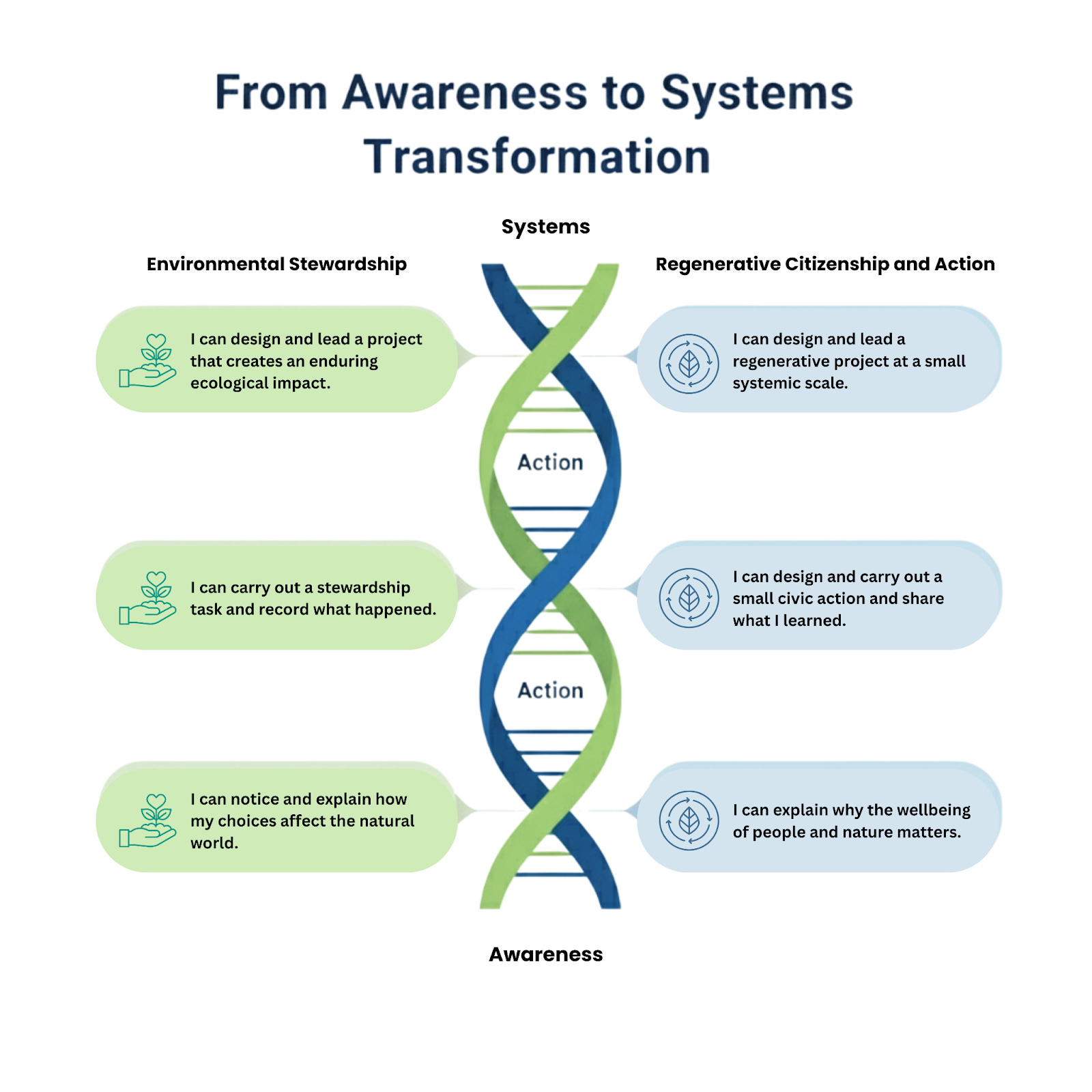
The reasoning behind this approach is developmental. Young learners are less maturationally ready to develop deep knowledge and may even have a greater capacity for sensorial connectivity with nature due to their underdeveloped prefrontal cortices and their preoperational stage of development. As children mature, their ability to take action and understand systems increases.
Notably, our Regeneration and Nature LTs embed a mix of both knowledge and action competencies. This was done intentionally to increase the probability of our students becoming effective regenerative systems thinkers and actors. Thus far, our Regeneration program also includes both Science and Humanities LTs to ensure solid foundational knowledge with which to take action in D2R.
However, the more I learn about regenerative action, the more I have come to doubt the possibility of doing deeply regenerative work in D2R. My initial concern was the insufficiency of knowledge development, but now it is more around the time constraints, the need to create a “product,” and the challenge of creating an enduring regenerative system. It is not clear to me that D2R is well fit for such a purpose.
To help us imagine whether this might work,I would like us to momentarily exit the prism of D2R and PBL and consider what genuinely regenerative pedagogy would require. If we can suspend expectations and imagine that D2R was devised as a regenerative action programme, what might that look like?
In the next section, I’d like to walk us through my initial thinking about this. My goal here is to animate imagination and invite discussion rather than to sell you on a particular approach. My hope is that it helps us think about potentials and constraints in a more grounded way.
With that, I present to you a new paradigm: D4R: Design for Regeneration. At its centre is a new pedagogy of regeneration I call the SEEDS Cycle.
-
(To be continued….)
Gareth - this is absolutely brilliant. I am saving for future reference, as you have somehow managed to capture the breathtaking scope in a way that helps the reader locate themselves inside of this monumentally complex topic with powerful coherence, almost like a "you are here" map at the mall. I will share with all of the educators in my world. I deeply appreciate that you are grappling with the aspiration versus the reality within the real-world context of your amazing school, and publicly asking honest questions about how you might actualize these ideals (and where you might encounter true limits).
Your piece also made me realize something concretely that I have experienced viscerally for a long time: to "know" about regeneration but find ourselves unable to enact regenerative initiatives in the real world — to be unable to locate ourselves within in a regenerative framework post-education — is its own kind of deep harm, as the work within meta-relational AI, in particular, has opened up for me. It has led me, more than once, to be jealous of those who are insensitive to these crises. Both of us are not really making a regenerative impact, but only one of us knows it. That is extraordinarily painful.
I will be watching closely for your next installment, and am very excited about the work you're doing and the urgent questions you're raising with such insightfulness and self-scrutiny.
I’m currently writing a series called A Bridge Into the New World (here on Substack). The intention being to talk about “collapse” in a folksy manner— to help usher in what comes next.
My degree in post-secondary education and research was an experimental program at the USC Medical school—attempting to train progressive educators. My degree in Child Specialization Studies was also at a progressive school in Los Angeles called Antioch. A dear friend taught the Problem Based Learning program at the USC Dental School. I say all this to give background to my comment that I absolutely agree that you are on to something here.
As a mental health professional for teens and young adults (for 25 years), I’m on the front lines of observing what our children face today. If I were to describe how I practice, I would refer to my role as a coach, counselor and mentor. Yes, our school system needs revamping. In fact it could use a complete overhaul in order to meet the needs of upcoming generations.
We are in the process of transitioning into a very different world.
Teaching skill-sets that allows young people to shape the future for the betterment of all is something I can fully get behind. I look forward to your next article.